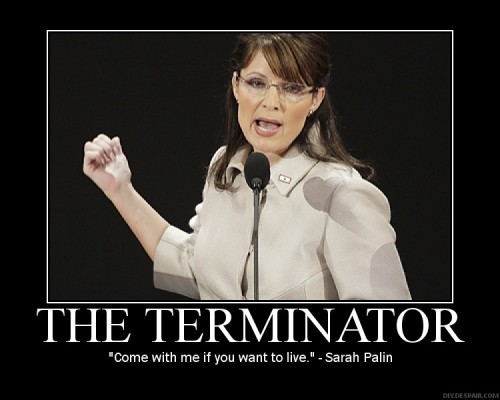
Sarah Palin is not done causing headaches for the leadership of the Republican Party.
In fact, my guess is that she is going to cause them far more pain in the near future than they or the media could ever have imagined.
At this point, politicians and the press are trying to decipher Palin’s motivation for her stunning announcement yesterday that she is resigning as governor of Alaska.
The standard analysis is that she is resigning in order to concentrate her efforts on securing the Republican nomination for president in 2012. As Bill Kristol told Fox News after Palin’s speech: “We just saw the opening statement of the 2012 campaign.”
Others — including NBC’s Andrea Mitchell — think Palin is stepping away from politics for good.
And some claim that Palin is resigning because of soon-to-be-announced scandals, including an alleged federal criminal investigation into the rebuilding of Palin’s home.
I think they’ve all missed the forest for the trees.
Sarah Palin isn’t done with politics.
But she might well be done with the Republican Party.
Rather than relying on alleged experts (who are not in Palin’s close circle) or taking the supposed word of unnamed sources, I suggest that the best indication of why Palin resigned – and what she plans to do – comes from Palin herself.
In her speech, she specifically states that she is not stepping away from politics. On the contrary, she repeatedly emphasized that she going to continue to work to “effect positive change,” although it would be from “outside government at this moment in time.” She was, she said, following in the never-give-up tradition of General Douglas MacArthur. “We’re not retreating,” she said, “we are advancing in another direction.’” (As the New York Times points out, Palin got the author of the quote wrong; it was not said by MacArthur, but by Maj. Gen. Oliver Prince Smith.)
She also was clear about the kind of “positive change” she planned to effect: she was going to continue to fight against “the heavy hand of federal government [intruding] into our communities with an all-knowing attitude,“ fight against “the obscene national debt that we’re forcing our children to pay because of today’s big government spending,” and “protect states’ rights, as mandated in the 10th Amendment.”
As she did during the 2008 campaign, Palin cast herself as the champion of the people: those “hardworking, average Americans fighting for what’s right” and those people “who still believe in free enterprise and smaller government and strong national security for our country and support for our troops and energy independence and for those who will protect freedom and equality and life.”
In other words, Palin sounded much same as she did during the presidential campaign – and she certainly didn’t sound like a person getting out of politics.
But there was a difference from her speeches during the presidential campaign.
And the difference involves the political party that she supports.
In her resignation speech, Palin said: “I’ll work hard for and I’ll campaign for those who are proud to be American and who are inspired by our ideals and they won’t deride them. I will support others who seek to serve in or out of office, and I don’t care what party they’re in or no party at all, inside Alaska or outside of Alaska.”
Repeatedly referring to her course of action as “unconventional,” “a new direction” and “no more politics as usual” — and comparing her actions to those of William H. Seward, (Lincoln’s Secretary of State who negotiated the purchase of Alaska — ”Seward’s Folly”), who took the “the uncomfortable, unconventional but right path to secure Alaska, so that Alaska could help secure the United States” — Palin dropped clue after clue that, like Seward, she too was going to take an “uncomfortable, unconventional but right path” to “help secure the United States.”
I think Sarah Palin told us what she is planning to do.
Yes, she is running for President.
But not necessarily as a Republican.
Sarah Palin has declared herself the leader of a movement, not merely a political party.
It was not a coincidence that Palin gave her speech on the weekend of Independence Day.
She just declared her independence from the Republican Party.
Categories: Culture · Politics
Tagged: 2012 election, 2012 presidential election, Andrea Mitchell, conservative politics, conservatives, far right, July 4, Palin, Palin resignation, Palin resigns, Politics, presidential election 2012, presidential politics, Republican Party, Republicans, right wing politics, Sarah Palin, third parties, third party Palin, William Kristol
One of the foundational principles of American democracy is under attack.

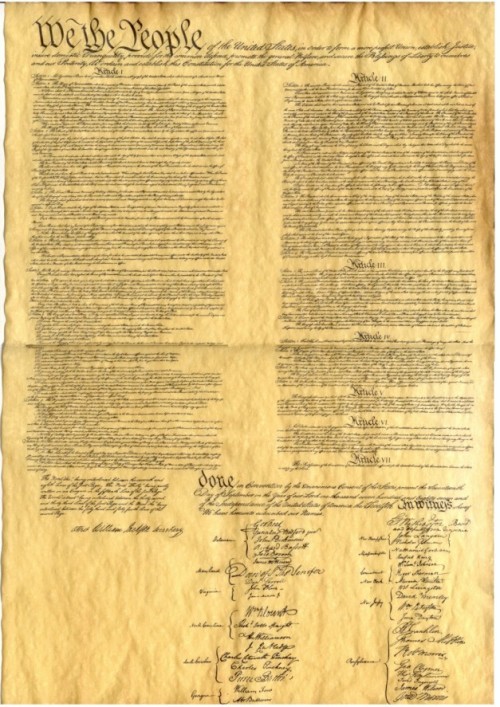
When the nation’s Founders crafted the United States Constitution in 1787, they were careful to include a requirement that:
“The Senators and Representatives shall receive a compensation for their services, to be ascertained by law, and paid out of the treasury of the United States.” (Art I, Sec. 6, Clause 1).
A similar provision for compensation applies to the president:
“The President shall, at stated Times, receive for his Services, a Compensation, which shall neither be increased nor diminished during the Period for which he shall have been elected, and he shall not receive within that Period any other Emolument from the United States, or any of them.” (Art II, Sec. 1, Clause 7).
The Founders understood that providing compensation for the new government’s elected officers was not a trivial matter, but an essential and cutting edge principle of the new democracy that they were striving to create — and one that directly and profoundly affected the kind of people who would be willing and able to serve as representatives of the people.
They knew too that no other nation on earth insisted on compensation for its elected officials.
In England, members of parliament as a rule served without pay. In colonial America, candidates for public office usually followed the practice of their English counterparts and promised to serve without compensation. In the states themselves, only Pennsylvania provided for “wages” from the “state treasury” to “all lawmakers.”
The Founders knew that this English aristocratic practice of not paying public officers created an enormous disadvantage for less wealthy candidates who could not afford to serve without receiving an adequate income for their efforts.
The Founders did not want public service to be a genteel avocation reserved for men of independent wealth, as it was in England, but wanted instead to create a system in which – as James Madison said – public office would be open to “those who have the most merit and least wealth.”
Fueled by the rhetoric of anti-government and anti-egalitarian demagogues (mostly in or allied with the Republican Party), this foundational and deeply American egalitarian principle is now under attack in this country – especially in California, where voters are responding to the state’s budget crisis by cutting the salaries of legislators and city officials, and where our billionaire governor constantly rails against legislative salaries and supports a 10 percent pay cut in legislative compensation.
But as the Founders knew – and we clearly have forgotten – adequate compensation for public officials is an essential element of a democratic government.
Cutting the salaries of public officials will mean that only the rich will able to serve – and when only the rich can serve, we will have the opposite of the government that Madison envisioned – one in which our representative have “the most wealth and the least merit.”
The Founders would not be pleased that the people are now so willingly – even eagerly – abandoning one of the fundamental principles of the American democracy that they fought to create.
Categories: Law · Politics
Tagged: Arnold Schwarzenegger, california, California Assembly, California budget, California budget crisis, California Legislature, California politics, Constitution, constitutional law, democracy, Founding Fathers, Governor Arnold Schwarzenegger, Governor Schwarzenegger, James Madison, U.S. Constitution, United States Constitution
Republican crocodile tears flowed this weekend in Orange County as a group of city officials called F.I.S.T. – “Fight Insane State Theft” – comprised of 14 Orange County mayors and 42 city council members, nearly all of them Republicans – protested Republican Governor Schwarzenegger’s plan to take away billions in state property tax revenue from their cities.

According to the Orange County Register, the group held a rally this past weekend in Placentia, joined by an array of Republican front organizations posing as anti-tax crusaders, including Citizens for a Better Placentia, Fullerton Association of Concerned Taxpayers, and Yorba Linda Residents for Responsible Representation.
The Register notes that the protesters are “particularly concerned about losing funds for roads and other transportation projects.”
But it is the Republicans themselves – and their corporate funded anti-tax allies – who are themselves directly responsible for giving the state the power to take away property tax revenue from California cities.
Prior to 1978, local governments in California (as elsewhere in the nation) could set their own property tax rates and spend the money that they raised on local needs.
But the Republicans did not trust local governments or local voters with the power to tax local property or to spend that revenue as they thought appropriate.
So they decided to give the state the sole power to set property taxes and to give the state legislature the sole power to decide how that money would be spent.
Prop 13 took away the cities’ power to set property tax rates or levy property taxes, and gave all such power to the state — where it would be subject to Prop 13’s strict limits and the 2/3 rule – in other words, subject to the statewide anti-tax minority’s veto, regardless of the wishes or needs of local officials or voters.
Now our local Republican elected officials and Republican anti-tax front groups are outraged about “losing funds for roads and other transportation projects” — which, by the way, tend to benefit large landowners and developers more than local citizens — because the state wants to spend that money elsewhere.
This latest instance of Orange County Republican hypocrisy reminds me of an exchange from Samuel Beckett’s play Waiting for Godot:
Estragon: We’ve no rights any more?
Laugh of Vladimir, stifled as before, less the smile.
Vladimir: You’d make me laugh if it wasn’t prohibited.
Estragon: We’ve lost our rights?
Vladimir: (distinctly). We got rid of them.
So I ask our Orange County Republicans: Having given up our rights, are you now ready to amend Prop 13 to return the property tax power to local governments and local voters?
Categories: Economics · Law · Politics
Tagged: Arnold Schwazenegger, california, California budget, California Legislature, California politics, California property tax, California Republican Party, California Republicans, California taxes, Coupal, Howard Jarvis, Howard Jarvis Taxpayers Association, Jon Coupal, Orange County, Orange County politics, Orange County Republicans, Orange County toll roads, Orange County Transportation, Orange County Transportation Corridor Agencies, Orange Couny taxes, Prop 13, Proposition 13, Republicans, Schwarzenegger, tax, tax revolt, taxes

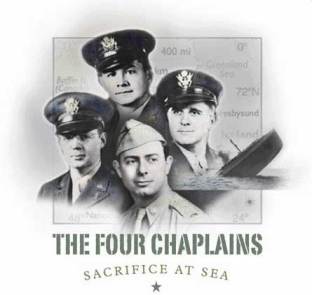
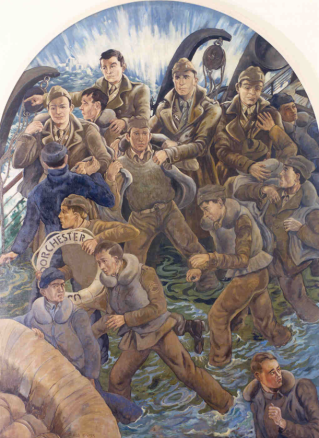
When I was child, my father, a World War II Navy veteran, taught me the story of the four chaplains of the USAT Dorchester.
I thought of the four chaplains during the presidential election when I listened to former Secretary of State Colin L. Powell explain why he endorsed Barack Obama for President of the United States.
In stating why he could not support the candidacy of John McCain, Powell referred to the death of U.S. Army Corporal Kareem Rashad Sultan Khan, a 20 year old from Manahawkin, N.J., who was killed in Iraq and to a photograph he had seen of the soldier’s mother pressing her head against his gravestone at Arlington National Cemetery.
The headstone was engraved with the soldier’s name, his military awards (the Purple Heart and Bronze Star), and the Muslim symbol of the crescent and star.
As the New York Times observed, “Powell mentioned Mr. Khan’s death to underscore why he was deeply troubled by Republican personal attacks on Mr. Obama, especially false intimations that he was Muslim. Mr. Obama is a lifelong Christian, not a Muslim, he said. But, he added, ‘The really right answer is, what if he is?’ ‘Is there something wrong with being Muslim in this country? No, that’s not America,’ he said. ’Now, we have got to stop polarizing ourselves in this way.’ Mr. Powell said that he had heard senior members of the Republican Party ‘drop this suggestion that he [Obama] is a Muslim and he might be associated with terrorists.’ ‘Now, John McCain is as nondiscriminatory as anyone I know. But I’m troubled about the fact that within the party we have these kinds of expressions.’”
General Powell probably thought, too, of the four chaplains of the USAT Dorchester.

On the night of February 3, 1943,United States Army Transport ship Dorchester was en route from Newfoundland to England via Greenland, when it was hit by torpedoes from a German submarine.
The Dorchester listed sharply to starboard and began to sink almost immediately into the icy water. The ship was overcrowded and there were insufficient lifeboats or lifejackets for the 904 men on board.
As the Dorchester sank, the ship’s four U.S. Army chaplains aided the wounded, helped get the men into lifeboats and then gave up their own lifejackets when the supply ran out.
A survivor later explained:
“As I swam away from the ship, I looked back. The flares had lighted everything. The bow came up high and she slid under. The last thing I saw, the four chaplains were up there praying for the safety of the men. They had done everything they could. I did not see them again. They themselves did not have a chance without their life jackets.”
As the ship went down, survivors in nearby lifeboats could see the four chaplains – their arms linked and braced against the slanting deck. Their voices could also be heard offering prayers.
Twenty-seven minutes after the torpedoes hit, the Dorchester was gone.
The four U.S. Army chaplains were:
Lt. George L. Fox, age 42, Methodist.
Lt. Alexander D. Goode, age 32, Jewish.
Lt. John P. Washington, age 34, Roman Catholic.
Lt. Clark V. Poling, age 32, Reformed Church in America.
According to the Four Chaplains Memorial Foundation, the lesson of their sacrifice is “unity without uniformity” and “selfless service to humanity without regard to race, creed, ethnicity, or religious beliefs.”
My father had a simpler lesson to teach me: We are all Americans.
In a speech on in Fayetteville, North Carolina, near Fort Bragg, Barack Obama said that “The men and women from Fayetteville and all across America who serve in our battlefields may be Democrats or Republicans or independents, but they have fought together and bled together and some died together under the same proud flag, They have not served a red America or a blue America. They have served the United States of America.”
(This post was originally published, in a slightly different form, on October 19, 2008.)
Categories: Culture · Politics
Tagged: Alexander D. Goode, Arlington National Cemetery, Barack Obama, bigotry, Bronze Star, chaplains, Colin L. Powell, Colin Powell, Cpl. Kareem Rashad Sultan Khan, democracy, Four Chaplains, Gen. Colin Powell, George L. Fox, Glark V. Poling, heroes, John P.Washington, Kareem Rashad Sultan Khan, McCain-Palin, Muslim Americans, Muslims, Obama, Politics, presidential campaign, Purple Heart, racism, religion, religion and politics, U.S. Army, USAT Dorchester, World War Two
With Orange County’s real estate and mortgage industry-driven economy in shambles and local home foreclosures on the rise, you might think that our Republican politicians would want to distance themselves from those who are profiting from the misery of Orange County voters who have lost or are about to lose their homes.
Not so.
The Orange County Business Journal recently featured a glowing cover article on local Republican contributor, fundraiser, and king-maker Dale Dykema, founder and chief executive of Santa Ana-based T.D. Service Financial Corp, which bills itself as “one of the nation’s largest and most successful” foreclosure processing firms.
Not surprisingly, Dykema’s firm is “looking at record profits this year amid the foreclosure wave.”
According to the Business Journal, Dykema has helped lenders foreclose on more than 450,000 homes, and expects the current foreclosure crisis to make this his best year ever, with his company taking in more than $70 million in foreclosure fees.
Dykema also expects his good fortune to continue as the local economy tanks.
As Dykema told the Business Journal, “It takes time for the foreclosures to hit after the economy dropped. I wouldn’t be surprised if we hit a peak next year for this time around.”
The focus of the Business Journal article, however, was not on Dykema’s success as a foreclosure-profiteer or his record profits, but on his role as an Orange County GOP king-maker.
Dykema, the Business Journal explained, “has helped GOP congressmen get elected with money and campaign advice. His beneficiaries include nearly all of the county’s congressional delegation: John Campbell, Ed Royce, Dana Rohrbacher, Ken Calvert, John Lewis, as well as former congressman and Securities and Exchange Commission Chairman Chris Cox.”
According to the Campaign Money website, Dykema contributed $54,450 to Republicans in 2008. He is also responsible for raising many thousands more from others.
Of course, all of the current GOP congressmen on this list voted against the stimulus legislation intended to relieve the economic crisis from which Dykema is profiting.
All of them oppose efforts to help homeowners avoid foreclosure.
And all of them, including former congressman Chris Cox, were instrumental in creating the deregulated mortgage mess that lead to the foreclosure crisis in the first place.
Amidst the rubble of Orange County’s housing market, Dykema and his Orange County Republican cronies can be proud of helping at least one business expand:
Dykema’s.
Categories: Economics · Politics
Tagged: Chris Cox, Christopher Cox, Congressman Dana Rohrbacjer, Congressman Ed Royce, Congressman John Campbell, Congressman Ken Calvert, Dale Dykema, Dana Rohrbacher, Ed Royce, Federal stimulus program, foreclosure, foreclosure crisis, John Campbell, Ken Calbert, mortage industry, mortgage crisis, mortgage meltdown, mortgages, Orange County, Orange County Business Journal, Orange County California, Orange County politics, Orange County Republicans, stimulous package, T.D. Service Financial, T.D. Service Financial Corp, TD Service Company
“And having looked to Government for bread, on the very first scarcity they will turn and bite the hand that fed them.”
Edmund Burke, Thoughts and Details on Scarcity
You might think that Orange County’s Republican elected officials would be caught between a rock and hard place in the current economic crisis.
With the local economy in shambles, home values crashing, foreclosures on the rise, unemployment skyrocketing and good jobs scarcer than Republican fans of Arnold Schwarzenegger, you might think that the staunch and total opposition of Orange County Republicans to President Obama’s stimulus efforts would be, at the least, a political embarrassment.
But then you would underestimate the shameless hypocrisy of Orange County’s Republican establishment.
In her most recent online newsletter, Republican Orange County Supervisor Pat Bates (District 5) makes the following incredible claim:
“Orange County Projects Receive Stimulus Funds
A number of significant environmental enhancement and flood management projects in Orange County will receive vital support from the American Recovery and Reinvestment Act of 2009, better known as the Federal stimulus program.
The U.S. Army Corps of Engineers has announced more than $50 million will be spent in Orange County on projects selected based on their anticipated economic and environmental return. The projects selected for funding include:
- $26,550,000 to complete channel improvements on the lower Santa Ana River within Orange County
- $1,000,000 for mitigation related to the Seven Oaks Dam, which provides flood protection to Orange, San Bernardino and Riverside Counties
- $17,363,000 to complete plans and specifications and award a construction contract for the environmental restoration of Upper Newport Bay
- $5,265,000 for needed maintenance for the Santa Ana River, Carbon Canyon Dam, Prado Dam and Fullerton Dam
- $500,000 for a Dana Point Harbor breakwater study to identify and recommend any repairs to the breakwater/jetties and improve water quality.
The approval of funding for these projects is great news for Orange County. Orange County residents will directly benefit from these improvements and the Federal support is greatly appreciated. Our success is the result of great teamwork involving our County staff, our representatives in Washington and many city and community leaders.”
In informing her constituents of this “great news,” Bates does not mention the fact that all of “our [Republican] representatives in Washington” voted against Obama’s economic stimulus legislation, including these very projects.
Nor does she mention the fact that all of Orange County’s Republican “city and community leaders” have been vocally attacking the stimulus package as an evil socialist plot to destroy capitalism.
And Bates does not mention the fact that every penny of the more than $50 million that she is so grateful that Orange County will receive from the stimulus package will come from — dare we say it – taxes.
What Bates should have said is the “great teamwork involving our Republican County staff, our Republican representatives in Washington and many Republican city and community leaders failed to prevent President Obama and the Democrats from passing the federal stimulus package – and thank God for that.”
Of course, Bates won’t say it.
But the voters in Orange County should.
Categories: Economics · Politics
Tagged: American Recovery and Reinvestment Act of 2009, Barack Obama, Carbon Canyon Dam, Edmund Burke, Federal stimulus program, Fullerton Dam, Obama, Orange County, Orange County Board of Supervisors, Orange County California, Orange County politics, Orange County Republican Party, Orange County Republicans, Orange County Supervisor Pat Bates, Pat Bates, Patricia Bates, Prado Dam, Santa Ana River, Seven Oaks Dam, stimulous package, U.S. Army Corps of Engineers, Upper Newport Bay

John Yoo
I have just returned from a debate on presidential power at Chapman University Law School.
In retrospect, the event should more properly have been called “The Trial of John Yoo.”
And strikingly, it was Yoo who cast himself in the role of defendant.
The debate was titled “Presidential Power and Success in Times of Crisis,” and the debaters included John Eastman, Dean of Chapman’s law school and one of the nation’s smartest (and therefore most dangerous) conservative legal scholars, as well as progressive Chapman law professors Katherine Darmer and Larry Rosenthal.
The first speaker and featured star attraction was John Yoo, currently Professor of Law at the University of California at Berkeley and Fletcher Jones Distinguished Visiting Professor of Law at Chapman, and the former Deputy Assistant Attorney General in the Office of Legal Counsel under President George W. Bush who co-authored the now-infamous memos justifying waterboarding and other forms of torture.
For those of us expecting a high power constitutional firefight over Bush era torture and presidential power, the debate was a letdown.
In fact, only one side – Darmer and Rosenthal – really addressed the scope of presidential power in the war on terror or the legal and ethical issues involved in the Bush administration’s torture program.
The other side – Yoo and Eastman – focused instead on the legal and ethical charges – only vaguely alluded to in the debate, but prominent in the media – against John Yoo himself.
Yoo’s self-defense consisted of unsubstantiated claims that torture (or what he called “enhanced interrogation”) was necessary to prevent a repeat of a 9-11 terrorist attack against the U.S., and strained analogies to prior unilateral presidential actions during wartime (such as Lincoln’s attempt to suspend habeas corpus during the civil war).
Most significantly, Yoo argued that President Bush — and, by clear implication, Yoo himself — should not be legally or morally judged in Obama era hindsight. Rather, Yoo claimed, the legal and moral judgment of the Bush administration’s policy on torture must take into consideration the legitimate fear of terrorism that gripped the nation immediately following the 9-11 attacks.
Professor Rosenthal aptly called this argument the “I lost my head” defense.
For now, I will leave to others the discussion of Bush era torture, as well as the extent of John Yoo’s personal moral and legal culpability.
What I want to note is that John Yoo knows that he is already on trial – not just in Spain, but here in the United States – and he is already attempting to put on his defense.
And if his performance at Chapman is an indication of his skill as his own defense attorney – and I think that it is – John Yoo is in serious trouble.
Yoo was meandering, inarticulate, and alternately simplistic and condescending. He was no match for Darmer and Rosenthal – both former federal prosecutors and both clearly far smarter and more savvy than John Yoo.
I came away from the debate feeling that Yoo is a rather pathetic figure, intellectually out-classed by the others on the panel.
Yoo’s rise in the legal world of the Bush administration was obviously more a product of his political beliefs and ultra-conservative connections – he clerked for Supreme Court Justice Clarence Thomas and Thomas’ friend and mentor Judge Laurence Silberman – than of his legal skill.
Yoo was probably not really even the primary author of the torture memos – that dubious distinction most likely belongs to his boss at the Office of Legal Counsel, former assistant attorney general and now federal appellate judge Jay Bybee.
And if John Eastman’s tepid and uncharacteristically dim performance as co-counsel for Yoo’s defense is an indication, Yoo may just end up as the designated fall guy for public outrage over Bush’s torture program.
At Chapman today, one sensed that John Yoo knew that he was the going to take the fall and that there was little, if anything, that he could do about it.
Categories: International · Law · Politics
Tagged: Bush administration, U.S. Constitution, Bill of Rights, United States Constitution, John Yoo, Dick Cheney, civil liberties, torture, presidential power, constitutional law, Law, President George W. Bush, John Eastman, Chapman, Chapman University, Chapman Law School, Chapman University School of Law, Katherine Darmer, Larry Rosenthal, Office of Legal Counsel, George Bush, George W. Bush, torture memos, terrorism, war on terror, Jay Bybee, Judge Jay Bybee, waterboarding, Interrogation Techniques, CIA, Central Intelligence Agency, 18 U.S.C. 2340, United Nations Convention Against Torture, Convention Against Torture, Yoo, Justice Department, Alberto Gonzales, interrogation, Abu Ghraib, Guantanamo

Nick Adenhart (1986-2009)
The death this month of 22-year-old Los Angeles Angels rookie pitcher Nick Adenhart – killed by a drunk driver just hours after making a spectacular season debut – has lead to outrage against drunk driving in general and in particular against the driver who killed Adenhart.
The drunk driver who killed Adenhart — Andrew Thomas Gallo, also 22-years-old – has been charged with three counts of murder, one felony count of fleeing the scene of a traffic collision involving death or permanent injury, one felony count of driving under the influence causing injury and one felony count of driving with a blood-alcohol level above the .08 percent that is the legal limit in California – Gallo’s blood alcohol level was three times higher than the legal limit – and causing bodily injury.
If convicted, Gallo could spend 55 years in prison.
Gallo is a particularly unsympathetic figure: he was on probation for a prior drunk driving conviction, was driving on a suspended license, and fled the scene after the crash.
Orange County District Attorney Tony Rackauckas expressed the community’s anger toward Gallo: “As the District Attorney, over the years I have seen some heart-wrenching things,” Rackauckas said during a media conference. “They don’t get much tougher than this. This Angel and his two friends were too young to be sent to heaven, but the defendant selfishly and recklessly got behind the wheel after getting drunk, and they didn’t have a choice…The defendant has acknowledged that he knew the dangers of drinking and driving based on his participation in this alcohol program… Knowing that he had caused this crash, Mr. Gallo cowardly fled the scene on foot without checking on the welfare of those he had just hurt.”
Of course, Rackauckas is correct.
But I question whether many of us are in a moral position to condemn Gallo.
There are people who don’t drink.
There are people who don’t drive.
Just about everyone else has driven drunk.
Especially in the car culture of Southern California – where it is just about impossible to get anywhere without getting behind the wheel – I venture to say that nearly everyone leaving a bar — or most people leaving a social occasion where they’ve consumed alcohol – are driving drunk.
Of course, most of these people don’t kill anyone.
But that’s just luck.
Coincidentally, in the midst of the outrage over Adenhart’s death, the Los Angeles Times reports that 70 sworn and civilian employees of the Los Angles County’s Sheriff’s Department were arrested for alcohol-related offenses last year, the majority for driving off-duty while under the influence of alcohol.
Each of them – and the hundreds more sherrif department employees who drove drunk but didn’t get caught — could easily have killed someone.
As could all of us who have ever gotten behind the wheel after drinking.
I am not suggesting that we should go easy on Gallo or other drunk drivers.
But in our culture of drinking and driving it is pure chance that many of us are not sitting in his place.
Categories: Culture · Law
Tagged: Adenhart, alcohol, alcoholism, Anaheim Angels, Andrew Gallo, Andrew Thomas Gallo, Angels baseball, baseball, drinking, drunk driving, DUI, DWI, LA Sherrif, Los Angeles Angels, Los Angles County’s Sheriff's Department, major league baseball, major leagues, mlb, Nick Adenhart, Orange County, Orange County District Attorney, sports, Tony Rackauckas

Democrats are responding to the growing nationwide phenomena of anti-tax “tea parties” protests by mocking them and by pointing out that they are prompted and run by right-wing organizations.
Neither response is a winning political strategy.
It is pure political stupidity — and bad economic policy — for Democrats to treat the tax protests with derision or contempt.
Rather than mocking the aims of the tea parties, Democrats should follow the lead of presidential candidate Barack Obama, who promised to “provide a tax cut for working families” and “restore fairness to the tax code and provide 95 percent of working Americans the tax relief they need.”
Obama also promised to provide tax relief for small businesses and startups by eliminating “all capital gains taxes on startup and small businesses to encourage innovation and job creation.”
What Obama recognized – and Democrats already seem to have forgotten – is that working families are in fact being over-taxed while the super rich have gotten a free ride – and that voters will cast their ballots for the party and the candidates who they believe will create a fairer tax code and reduce their tax burden.
And while it is certainly legitimate to point out that the anti-tax tea parties are being manipulated and guided by right-wing groups and talk-show hosts whose agendas are not the same as working and middle class voters, this point is devoid of political impact unless it is accompanied by a commitment to do a better job than these groups of protecting working class and middle class economic interests.
For too long, Democrats – especially in California – have allowed Republicans to dominate and set the terms of the tax debate.
As a result, Democrats have allowed Republicans to paint them as the party of higher taxes – and have allowed the super rich to pretend to defend the economic interests of working families and the middle class while in fact shifting the costs of government to those who are least able to afford it.
Instead of responding to the tax protests with mockery and contempt, Democrats need to insist on talking about the kinds of taxes that the government imposes and who pays them.
We should insist that all taxes be progressive and focused on overturning the Republican’s outrageous favoritism of the super rich.
Especially in the midst of the current recession, we should oppose any increases whatsoever in regressive taxes – such as the sales tax, the automobile tax, and the gasoline tax – that disproportionately hit working and middle class families, unless and until the state and federal tax code is revised to require that the super rich pay their fair share.
Of course these tax protest “tea parties” are a Republican sham — the Republican anti-tax activists not interested in reducing the tax burden on the middle class and working families, but in keeping the Bush tax breaks for the rich — but that does not mean that the underlying middle class protest — even rage — at their tax burden should be ridiculed. On the contrary, it means that the Democrats should insist on seizing the debate and turning it against the Republicans — as Obama did.
Democrats can win the tax debate – if they take the tax protest “tea parties” seriously.
Related posts:
Why I Love Conservative Talk Radio’s John and Ken Show
The Charge of the Democrat Light Brigade: California Democrats Caught in Republican Tax Trap
Why the Republican Anti-Tax Movement Doesn’t Care About the Taxes that YOU Pay
Categories: Economics · Law · Politics
Tagged: anti-tax movement, automoble tax, california, California budget, California budget crisis, California Democratic Party, California Democrats, California politics, California property tax, California Republican Party, California Republicans, California taxes, Democratic Party, democrats, elections, gasoline tax, Grover Norquist, Howard Jarvis, middle class, Obama campaign, Orange County, Orange County politics, Paul Krugman, Politics, progressive taxes, Prop 13, recession, regressive taxes, Republicans, sales tax, tax revolt, taxes, tea parties, tea party